Blogs
What is a trading conversation? Key skills for edge
Aman Anand
Most traders think of their edge as a private formula, something built in silence with charts, indicators, and backtested data. But the reality is that some of the most profitable decisions in trading history were shaped by a conversation. Whether it was a quick exchange on a noisy floor or a message in a digital chat room, trading conversations have always been at the center of how markets move. This guide breaks down what a trading conversation actually is, how it has evolved, why it matters for your performance, and which skills will help you use it as a genuine competitive advantage.
Table of Contents
Why trading conversations matter for performance and learning
Best practices and tools for mastering trading conversations
Key Takeaways
Point | Details |
|---|---|
Trading conversation basics | Trading conversations are all about timely information exchange that influences decisions and execution. |
Technology transforms dialogue | Chat rooms and digital tools now underpin most trading conversations, replacing old floor methods. |
Collaboration boosts results | Effective trading conversations sharpen decisions, manage risk, and speed up learning for individuals and teams. |
Critical conversation skills | Clarity, listening, and adaptability are core to thriving in any trading discussion. |
Tool selection matters | Choosing the right platform is key for tracking, archiving, and optimizing trading conversations. |
Defining a trading conversation
Building on the idea that trading goes beyond numbers, let's clarify exactly what constitutes a trading conversation. At its core, a trading conversation is the exchange of information and intentions among market participants before, during, or after a trade. It is not just small talk. Every word, signal, or message carries weight because it can influence timing, position sizing, or the decision to act at all.
"On traditional trading floors, trading conversations involve verbal shouting, hand signals, body language, and electronic systems for quick trade execution and information exchange."
Traditional examples include open outcry pits where traders used rapid verbal exchanges and hand signals to communicate bids and offers in real time. Modern examples look very different: online chat rooms, direct messages, shared screens, and voice calls over platforms like Discord or Slack. The format has changed, but the core elements remain consistent.
Key elements of any effective trading conversation include:
Speed: Information must be delivered and received quickly, especially in volatile markets.
Clarity: Ambiguous language leads to costly misinterpretations.
Trust: Participants must believe the information shared is accurate and relevant.
Relevance: Only actionable information belongs in a trading conversation.
Intention: Every message should have a clear purpose, whether it is to confirm, question, or inform.
When you build a rule-based trading strategy, these same principles apply. Clear rules reduce ambiguity, just as clear communication does in a live conversation.
Evolution: From trading floor to digital chat rooms
Having defined what a trading conversation is, it is essential to see how its context and methods have evolved. On the floor, trading conversations were physical and immediate. Crowd psychology played a huge role. You could read a trader's body language, sense panic or confidence in the room, and adjust your position accordingly.
Today, electronic systems have largely replaced verbal and hand signal communication, shifting the action to tiered group chats, direct messages, and real-time collaborative platforms. Globalization and regulation also pushed this transition, as digital records provide accountability that shouted orders never could.
Feature | Traditional floor trading | Modern digital trading |
|---|---|---|
Speed | Fast but limited by physical presence | Near-instant, global reach |
Record keeping | Minimal, memory-based | Fully archived and searchable |
Collaboration | In-person, localized | Remote, cross-timezone |
Emotional cues | Body language, tone of voice | Emojis, response time, word choice |
Skill required | Volume, presence, quick reflexes | Brevity, clarity, tech fluency |
Pro Tip: In digital trading environments, brevity and precision carry more weight than personality or volume. A short, well-timed message in a group chat can move faster than a long explanation. Practice writing your trade thesis in two sentences or fewer.
Tracking how your communication style affects outcomes is just as important as tracking trade performance. And when you are optimizing trading decisions for a quantitative edge, the quality of your conversations feeds directly into the quality of your data.
Why trading conversations matter for performance and learning
Now that we understand how trading conversations have changed, it is time to highlight exactly why they are game-changing for your results. The most immediate benefit is access to diverse perspectives. When you engage in a structured trading conversation, you expose your thesis to scrutiny, which reduces blindspots that solo analysis often misses.

During market shocks, groups that communicate effectively reach consensus faster and adapt their positions with more confidence. Collaborative real-time sharing enhances collective decision-making and speeds up the dissemination of critical trade information, which is a measurable advantage when seconds count.
Post-trade debriefs are another underused tool. Teams that review their conversations after major market moves identify pattern errors and communication gaps that would otherwise repeat. Research consistently shows that structured debriefs improve decision quality in high-stakes environments.
Here is how trading conversations add value at each stage of the process:
Idea generation: Conversations surface setups and opportunities that one trader might overlook.
Confirmation and consensus: A second opinion before entry reduces impulsive decisions.
Real-time adaptation: Live chat during a trade allows rapid adjustment when conditions shift.
Debrief and iteration: Post-trade review locks in lessons and prevents repeated mistakes.
For solo traders, plugging into a community or using a structured platform to log your thinking out loud replicates many of these benefits. Pairing this with proven spot trading strategies and algorithmic risk management creates a feedback loop that compounds over time.
Key skills for effective trading conversations
We have seen the benefits of trading conversations, but which concrete skills matter most for excelling in them? The first is active listening, and yes, this applies to text-based chat too. Reading carefully, noticing what is not said, and picking up on hesitation or urgency in someone's message are all forms of active listening that sharpen your read on market sentiment.
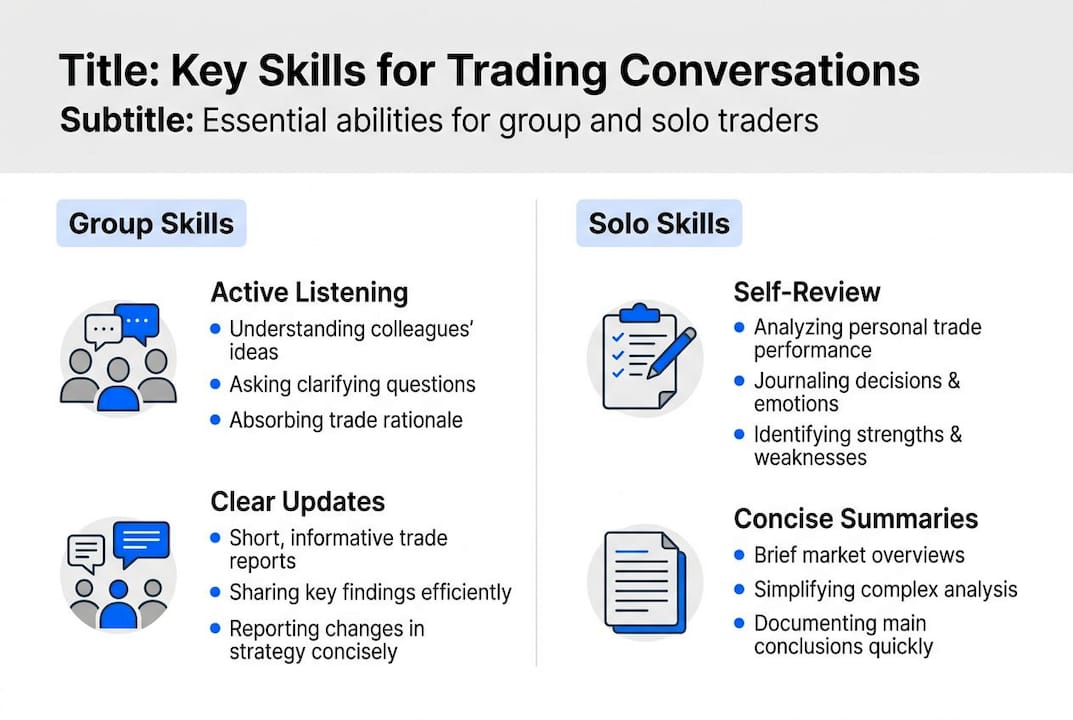
Modern online communication demands clarity, relevance, and concise information for effective trade execution. This means the second critical skill is clear and concise expression. Long, rambling messages in a fast-moving chat lose their audience and their impact.
Here are the core skills every trader should develop:
Active listening: Read carefully, notice tone and urgency, and ask clarifying questions before acting.
Concise expression: State your thesis, your level, and your reasoning in as few words as possible.
Confidentiality and judgment: Know what to share, with whom, and when. Not every insight belongs in a public channel.
Open-mindedness: Treat pushback as data, not as a personal challenge. The best traders update their views when the evidence changes.
Emotional neutrality: Keep your language factual and calm, especially during volatile sessions.
Pro Tip: Develop a "summary and confirm" habit. After any significant trading conversation, write a one-line summary of what was agreed or decided and share it with the group. This eliminates misalignment and creates a record you can review later.
Combining these skills with AI-driven trading insights gives you a powerful combination of human intuition and data-backed analysis.
Best practices and tools for mastering trading conversations
With skills in mind, let us move into specific tools, best practices, and structures that help you translate theory into daily trading advantage. The platform you choose matters more than most traders realize. Digital platforms facilitate collaborative trading conversations, record decision flows, and enhance group execution, but only if they have the right features.
Here is a step-by-step framework for building a high-quality trading communication system:
Pick a platform with strong group chat, direct messaging, search functionality, and security. Discord, Slack, and purpose-built trading platforms all offer different tradeoffs.
Set communication guidelines for your group. Define what belongs in each channel, how to flag urgent information, and what level of detail is expected.
Use recording and archiving to review past conversations. Patterns in how your group communicates before winning and losing trades are extremely revealing.
Schedule regular debriefs after significant market events. Even a 15-minute structured review builds compounding knowledge over weeks and months.
Platform | Key features | Best use case |
|---|---|---|
Discord | Group channels, voice, bots | Retail trading communities |
Slack | Threaded chat, integrations, search | Small professional trading teams |
Telegram | Fast messaging, large groups | News and signal sharing |
Purpose-built trading platforms | Analytics, trade logging, chat | Institutional and serious retail traders |
For traders focused on results, tracking chat-based trading results alongside your trade log creates a complete picture of how communication affects outcomes. Exploring quant trading platforms that integrate communication and analytics is a logical next step for anyone serious about systematic improvement.
Enhance your trading edge with Nvestiq
To translate these best practices into your trading routine, consider a platform designed specifically for high-performance trading communication and decision support.

The Nvestiq platform was built to bridge the gap between trader intuition and quantifiable results. It is the world's first platform that can comprehend the nuance of a real trader's thinking, allowing you to turn a simple conversation into a proven, measurable edge. Whether you are refining your rule-based strategies or looking to capture insights from your daily trading conversations, Nvestiq gives you the tools to make that process systematic and repeatable. Explore the platform today and see how structured communication can become one of your most reliable performance drivers.
Frequently asked questions
What does a typical trading conversation look like?
A typical trading conversation involves quick back-and-forth exchanges about intentions, market conditions, and confirmations, using chat platforms or voice calls depending on the setting and urgency.
How have trading conversations changed with technology?
Trading conversations now rely on digital chat rooms and platforms, enabling faster, broader, and fully recorded communication compared to the noise and physical limits of traditional trading floors.
Why are trading conversations important for solo traders?
Solo traders benefit from collective decision-making by joining trading communities or structured platforms, which helps them crowdsource insights, reduce blindspots, and improve decision quality through shared intelligence.
What tool features support better trading conversations?
The most valuable features include group chat, direct messaging, message search, security controls, conversation archiving, and easy integration with analytics tools to connect communication patterns to trade outcomes.