
Blogs
Trading Bias Explained: Types, Costs, and Fixes
Nick Garidzhuk
Rational decisions often slip through the cracks when trading meets human psychology. Many beginner and intermediate traders notice gains vanish or unexpected losses stack up, yet the reasons stay unclear. Understanding your own cognitive distortions and how they shape investment choices is the first step to making better, data-driven decisions. This introduction will shed light on major types of trading bias, common misconceptions that hold traders back, and practical ways to measure and manage these hidden patterns.
Table of Contents
Key Takeaways
Point | Details |
|---|---|
Understanding Trading Bias | Trading biases are systematic psychological distortions that affect decision-making in financial markets. Recognizing them is essential for improving trading performance. |
Impact of Demographics | Factors such as age, education, and trading experience influence how biases manifest. Younger traders may exhibit greater overconfidence, while experienced traders may develop more complex distortions. |
Technological Mitigation | Advanced technologies, such as machine learning and predictive modeling, can help identify and mitigate cognitive biases in trading. Implementing these tools can enhance decision-making accuracy. |
Frequent Mistakes to Avoid | Common bias-driven mistakes include confirmation bias and the sunk cost fallacy. Maintaining a structured decision-making process can help avoid these pitfalls. |
Trading Bias Defined and Common Misconceptions
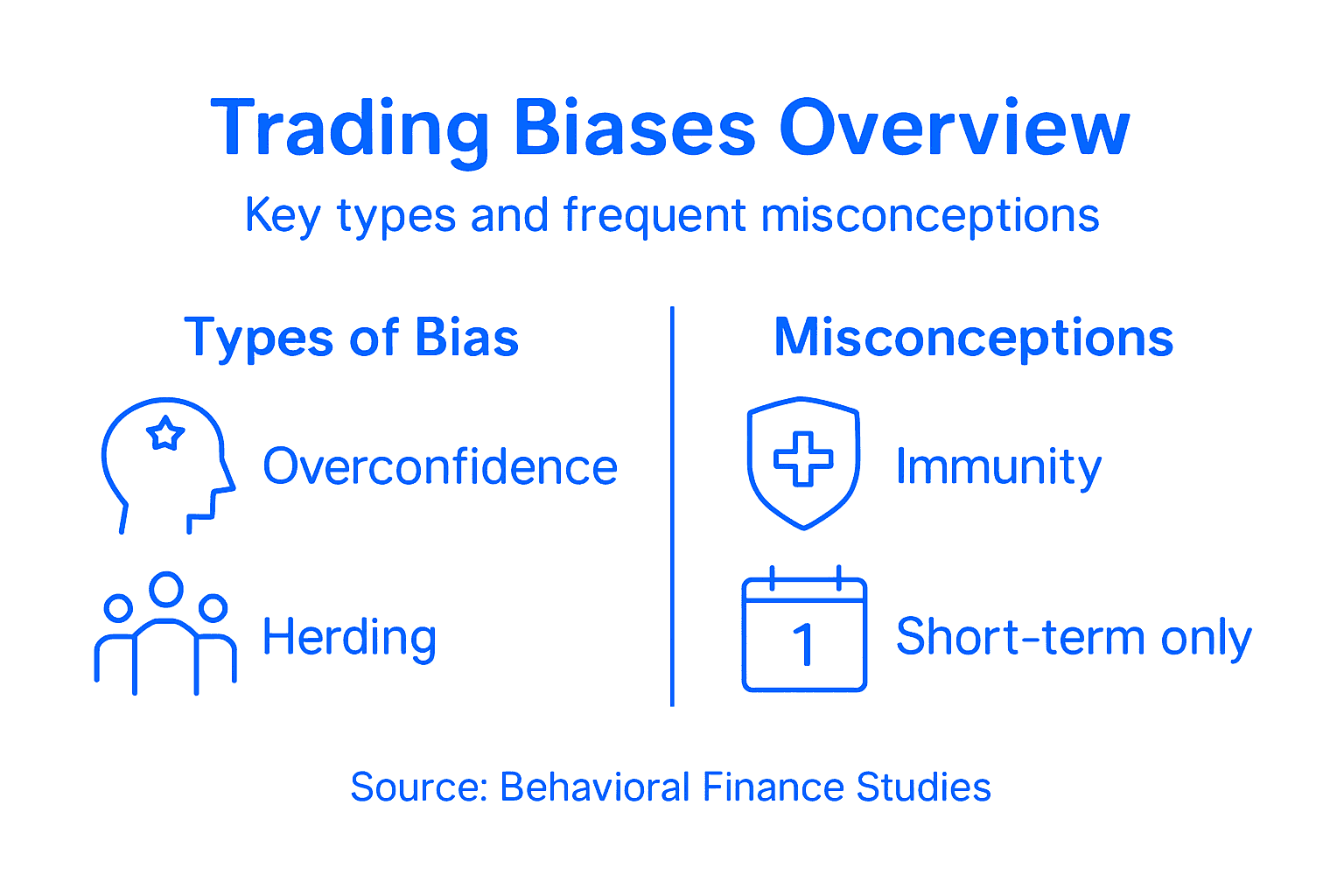
Trading bias represents a systematic deviation in thinking that distorts rational decision-making during financial transactions. Cognitive distortions can dramatically influence investment choices, often without traders realizing their impact. These psychological patterns emerge from ingrained mental shortcuts that create predictable - yet potentially dangerous - trading behaviors.
Researchers have identified several key trading biases that consistently impact investor performance. According to behavioral finance studies on market participants, these biases manifest in predictable ways:
Overconfidence Bias: Traders overestimate their predictive abilities
Loss Aversion Bias: Tendency to feel losses more intensely than equivalent gains
Confirmation Bias: Seeking information that validates existing beliefs
Herding Bias: Making decisions based on group behavior rather than independent analysis
Understanding these biases requires recognizing that they are deeply rooted psychological mechanisms. Cognitive research on emerging markets reveals that demographic factors like age, education, and trading experience significantly moderate how these biases manifest.
Common misconceptions about trading bias often stem from oversimplified assumptions. Many traders believe they are immune to psychological influences, creating a dangerous blind spot. In reality, even professional investors with advanced training can fall prey to these cognitive traps. The human brain’s tendency to seek patterns and minimize uncertainty makes everyone susceptible.

Pro tip: Develop a systematic trading approach that includes pre-defined rules to counteract potential cognitive biases and emotional decision-making.
Major Types of Trading Bias in Markets
Trading biases represent complex psychological phenomena that systematically distort investment decision-making across financial markets. Extensive research on cognitive patterns reveals multiple distinct types of biases that significantly impact trader performance and market dynamics.
The primary types of trading biases include:
Overconfidence Bias: Traders systematically overestimate their predictive capabilities
Loss Aversion Bias: Experiencing losses as more emotionally painful than equivalent gains
Confirmation Bias: Actively seeking information that validates existing beliefs
Herding Bias: Making decisions based on collective group behavior
Anchoring Bias: Relying too heavily on initial reference points
Recency Bias: Giving disproportionate weight to recent market events
Market behavioral research on herding mechanisms demonstrates that these biases operate through complex psychological pathways. Emotional contagion, social conformity, and information cascades drive traders toward collective decision-making patterns that can dramatically influence market movements.
Understanding these biases requires recognizing their nuanced manifestations. Demographic factors like age, trading experience, and educational background significantly moderate how these cognitive distortions emerge. Professional investors are not immune - even sophisticated traders can unconsciously succumb to these psychological traps that systematically deviate from purely rational decision-making.

Pro tip: Develop a structured trading journal that objectively tracks your decision-making process, helping you identify and mitigate personal cognitive biases.
How Bias Impacts Trading Outcomes
Emerging market research on trading behaviors reveals that cognitive biases dramatically transform trading performance, creating substantial differences between potential and actual investment outcomes. These psychological mechanisms fundamentally reshape how traders perceive risk, make decisions, and ultimately interact with financial markets.
The primary ways trading biases impact outcomes include:
Financial Performance Reduction: Biased decisions lead to suboptimal trading strategies
Risk Management Distortion: Misinterpreting market signals and potential threats
Portfolio Composition Alteration: Making investment choices based on emotional responses
Trading Frequency Modification: Overconfidence or fear driving excessive or limited trading activity
Market maker behavioral research demonstrates that institutional-level biases can create systemic market inefficiencies. Overconfidence bias, in particular, can significantly influence market liquidity, price formation, and overall trading environment stability.
Demographic factors such as age, education, and trading experience further complicate these bias impacts. Younger traders might exhibit more pronounced overconfidence, while experienced investors could develop more nuanced but equally problematic cognitive distortions. Understanding these variations is crucial for developing robust, self-aware trading strategies that can mitigate the destructive potential of unconscious psychological patterns.
Here’s a summary of how demographic factors can influence the expression of trading biases:
Demographic Factor | Influence on Biases | Typical Outcome in Trading |
|---|---|---|
Age | Younger traders are more overconfident | Increased risk-taking, higher trading frequency |
Trading Experience | More experience leads to nuanced biases | Complex cognitive distortions, not necessarily fewer mistakes |
Education Level | Higher education improves awareness | Some bias reduction, but not immunity |
Pro tip: Implement a structured self-assessment process that regularly reviews your trading decisions, helping you identify and neutralize personal cognitive biases.
Quantifying and Mitigating Bias with Technology
AI bias mitigation frameworks represent a critical technological approach to understanding and neutralizing cognitive distortions in trading environments. Advanced computational techniques now enable traders to systematically identify, measure, and counteract psychological patterns that traditionally undermined decision-making processes.
Key technological strategies for bias quantification include:
Machine Learning Algorithms: Detecting pattern recognition in historical trading decisions
Statistical Analysis Tools: Measuring deviation from rational investment strategies
Behavioral Tracking Software: Recording and analyzing individual trading behavior
Predictive Modeling: Simulating potential bias-influenced outcomes
Psychological Profiling Technologies: Understanding individual cognitive risk factors
Socio-technical bias evaluation methods provide sophisticated frameworks for assessing technological interventions. Experimental platforms now enable traders to systematically test and mitigate cognitive biases by creating controlled environments that reveal unconscious decision-making tendencies.
The most advanced bias mitigation technologies integrate multiple approaches, combining psychological insights with computational analysis. These systems go beyond simple detection, offering real-time interventions that help traders recognize and redirect potentially irrational decision patterns before they can impact investment performance.
This table provides an overview of leading technology approaches for mitigating trading biases:
Technology Solution | Main Function | Example Benefit |
|---|---|---|
Machine Learning Algorithms | Identify hidden patterns in behavior | Early detection of bias trends |
Behavioral Tracking Software | Monitor real-time decisions | Immediate feedback on actions |
Predictive Modeling | Simulate bias-influenced outcomes | Improved scenario planning |
Psychological Profiling | Assess individual risk factors | Customized trader interventions |
Pro tip: Implement AI-powered trading journals that automatically flag potential cognitive bias indicators in your decision-making process.
Frequent Bias-Driven Mistakes to Avoid
Statistical bias analysis reveals that traders consistently fall into predictable psychological traps that dramatically undermine their investment performance. Understanding these common mistakes becomes crucial for developing more rational, disciplined trading approaches that minimize emotional decision-making.
The most prevalent bias-driven mistakes include:
Confirmation Bias Trap: Seeking only information that validates existing beliefs
Sunk Cost Fallacy: Continuing to lose trades to justify previous investments
Recency Bias: Overemphasizing recent market events while ignoring long-term trends
Anchoring Bias: Fixating on initial price points or historical reference markers
Herding Mentality: Making decisions based on crowd behavior rather than independent analysis
Machine learning pitfall research demonstrates that these biases can invalidate entire trading strategies. Cognitive distortions frequently lead traders to make systematic errors in judgment, creating a cascade of poor decisions that compound financial risks.
Professional traders recognize that bias mitigation requires constant vigilance and structured self-assessment. The most successful investors develop robust mental frameworks that challenge their assumptions, seek contradictory evidence, and maintain emotional distance from their trading decisions. This approach transforms bias from an unconscious vulnerability into a manageable aspect of financial decision-making.
Pro tip: Create a structured decision-making checklist that forces you to consider alternative perspectives and challenge your initial trading assumptions.
Overcome Trading Biases and Gain a Real Edge Today
The article highlights how trading biases such as overconfidence and confirmation bias can silently undermine your decision-making and financial performance. These cognitive traps create emotional hurdles that even experienced traders find hard to escape. If you struggle to recognize and control these biases, your trading results may fall short of your potential despite your knowledge and effort. Understanding your behavioral patterns is the first step toward smarter, more rational trading.
At Nvestiq, we have created the world’s first platform that truly understands the subtlety of a real trader’s intuition. Our innovative technology helps you transform simple conversations into a proven, quantifiable edge, empowering you to detect and counteract bias before it impacts your trades. Take control of your emotions and decisions with tools designed to track your personal trading behavior and reveal hidden patterns like anchoring and herding biases. Join thousands of traders who are building self-awareness and improving outcomes with our unique system.
Ready to turn your trading intuition into a scientific advantage? Reduce the risk of costly bias-driven mistakes and start making more objective decisions. Explore how Nvestiq’s platform can sharpen your strategy by linking your instinct to data. Visit us today and take the first step to training your mind for success with Nvestiq.
Frequently Asked Questions
What is trading bias?
Trading bias refers to systematic biases in thinking that impair rational decision-making during trading.
What are common types of trading biases?
Common types include overconfidence bias, loss aversion bias, confirmation bias, herding bias, anchoring bias, and recency bias.
How does trading bias affect investment performance?
Trading bias can lead to suboptimal strategies, impaired risk management, and emotional decision-making, ultimately decreasing financial performance.
How can traders mitigate trading biases?
Traders can mitigate biases by developing structured decision-making processes, using technology to track behavior, and maintaining a trading journal to identify cognitive patterns.