Blogs
Why Use Trading Algorithms: Maximizing Edge, Minimizing Risk
Nick Garidzhuk
Every experienced algorithmic trader eventually faces the challenge of separating practical features of trading algorithms from popular myths. As machine learning models play a growing role in predicting market movement, the reality is clear—these systems are powerful, but they are tools, not profit guarantees. For professionals aiming to refine strategy, understanding the distinction between systematic data-driven decision-making and hype is key. This article offers nuanced insights to help you build precision, adaptability, and explainability into your algorithmic trading.
Table of Contents
Key Takeaways
Point | Details |
|---|---|
Trading Algorithms Are Tools, Not Guarantees | Trading algorithms require continuous refinement and monitoring; they are not guaranteed to generate profit. |
Types of Algorithms Serve Different Purposes | Understanding the distinctions among algorithm types can enhance trading strategies and align them with investment goals. |
Conversation-Driven Algorithms Offer Advanced Insights | These algorithms can process complex data and mimic human reasoning, enabling more context-aware trading decisions. |
Regulatory Compliance Is Crucial | Developing robust governance frameworks and proactive risk management strategies is essential to prevent market manipulation risks in algorithmic trading. |
Defining Trading Algorithms And Common Myths
Trading algorithms are sophisticated computational strategies designed to execute financial transactions automatically based on predefined rules and mathematical models. These advanced systems leverage complex mathematical frameworks to analyze market conditions, detect potential trading opportunities, and execute trades with precision and speed far beyond human capabilities.
At their core, trading algorithms are a systematic approach to financial markets that utilize machine learning techniques for market prediction. Unlike popular misconceptions, these algorithms are not magical money-making machines but carefully constructed tools that require continuous monitoring and refinement.
Key characteristics of trading algorithms include:
Data-driven decision making: Analyzing massive datasets to identify market patterns
Rapid execution speeds: Processing transactions in milliseconds
Emotionless trading: Eliminating psychological biases inherent in manual trading
Risk management: Implementing strict rules to control potential losses
Consistency: Following predetermined strategies without deviation
Many traders mistakenly believe trading algorithms guarantee profits. However, the Dutch Authority for the Financial Markets emphasizes that these systems are probabilistic tools, not guaranteed sources of income. Professional algorithmic traders understand that successful strategies require continuous optimization, backtesting, and adaptive learning.
Pro tip: Always view trading algorithms as strategic tools requiring ongoing refinement, not guaranteed profit machines.
Types Of Trading Algorithms And Key Distinctions
Trading algorithms represent a diverse landscape of computational strategies, each designed to address specific market challenges and trading objectives. These sophisticated systems can be categorized based on their underlying methodologies, computational approaches, and primary market functions.
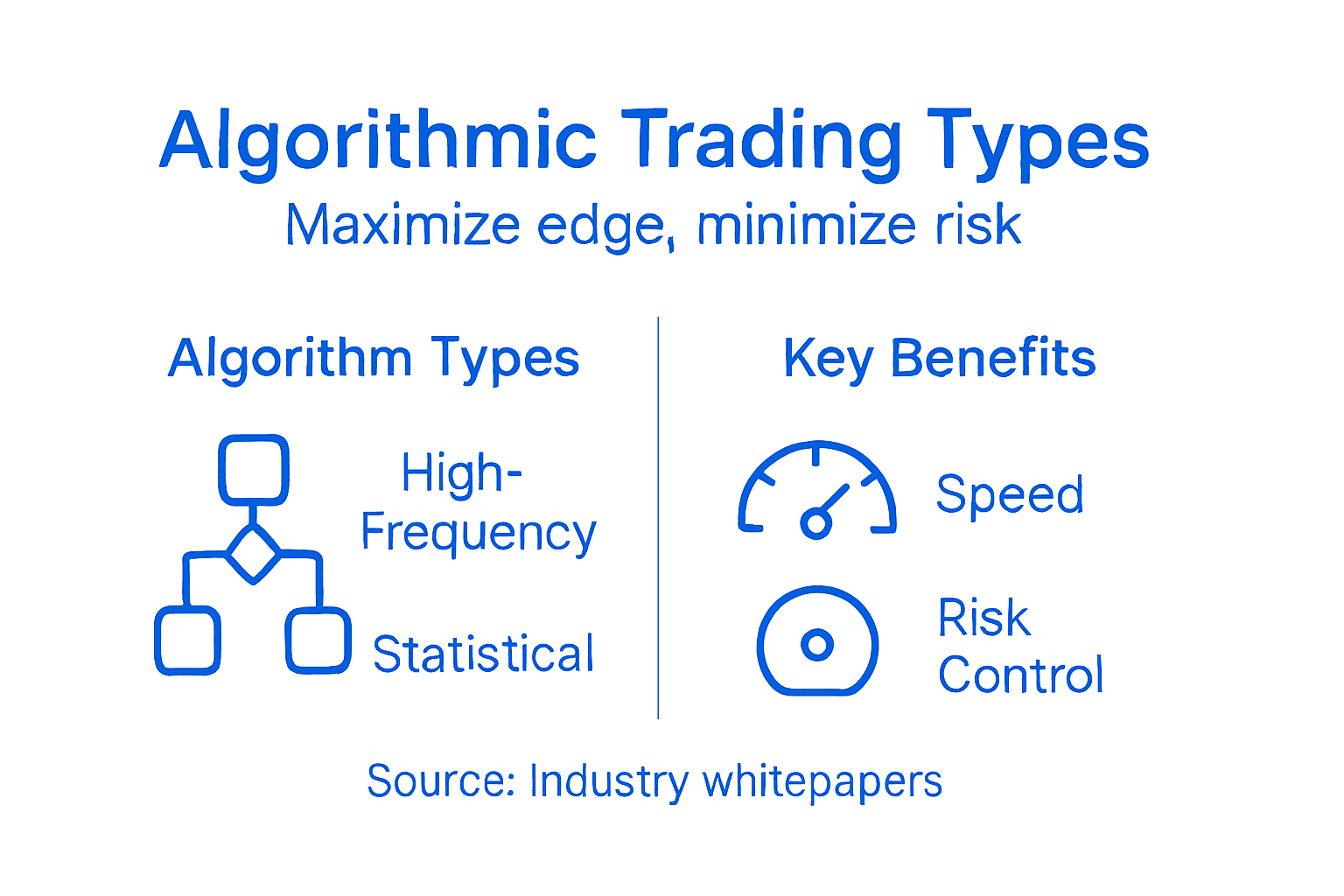
Modern trading algorithms typically fall into several distinct categories, with machine learning techniques driving advanced market predictions. The primary types of algorithmic trading strategies include:
Rule-Based Algorithms: Operate on predefined mathematical rules and logical conditions
High-Frequency Trading (HFT): Execute multiple trades within milliseconds
Machine Learning Algorithms: Adapt and learn from market data patterns
Statistical Arbitrage Algorithms: Exploit pricing inefficiencies across markets
Sentiment Analysis Algorithms: Analyze market sentiment from news and social media
Each algorithmic type brings unique advantages and computational complexities. High-frequency trading algorithms, for instance, focus on executing thousands of trades per second, while machine learning algorithms leverage advanced neural networks to identify complex market patterns that traditional methods might overlook.
The computational sophistication varies significantly across these algorithm types. Some rely on simple statistical models, while others employ complex deep learning frameworks that can process multiple market signals simultaneously, adapting in real-time to changing market conditions.
Pro tip: Select trading algorithms that align closely with your specific investment strategy and risk tolerance, understanding that no single approach guarantees consistent market success.
Here’s a summary highlighting distinctions among popular trading algorithm types:
Algorithm Type | Example Use Case | Computational Complexity | Adaptability |
|---|---|---|---|
Rule-Based | Automated stop-loss orders | Moderate | Fixed rules only |
High-Frequency Trading | Arbitrage across exchanges | Very high | Real-time adjustments |
Machine Learning | Predicting price movements | Advanced | Learns from new data |
Statistical Arbitrage | Exploiting market inefficiencies | High | Adapts to shifting patterns |
Sentiment Analysis | Trading on news/social mood | Advanced | Responds to content changes |
How Conversation-Driven Algorithms Enhance Strategy
Conversation-driven algorithms represent a groundbreaking approach to trading, transforming how traders interact with complex market data through advanced natural language processing technologies. These sophisticated systems go beyond traditional computational methods by integrating human-like reasoning and contextual understanding into trading strategies.
Large language models are revolutionizing algorithmic trading by processing diverse financial information dynamically. These conversational AI systems can interpret multiple data streams simultaneously, including:
News sentiment analysis: Extracting market insights from real-time news sources
Social media signals: Monitoring public perception and market mood
Qualitative data interpretation: Understanding nuanced linguistic context beyond numeric data
Multi-source information synthesis: Combining diverse information types
Adaptive reasoning: Generating trading hypotheses based on complex linguistic inputs
The core innovation of conversation-driven algorithms lies in their ability to mimic human cognitive processes. Unlike traditional algorithms that rely solely on quantitative data, these advanced systems can understand context, interpret subtle market signals, and generate trading strategies that adapt in real-time to changing market conditions.

Traders utilizing these algorithms gain a significant competitive advantage by accessing multi-dimensional insights that traditional computational methods might overlook. The integration of natural language processing allows for more nuanced, contextually aware trading decisions that can potentially reduce risk and improve overall strategy effectiveness.
Pro tip: Continuously train your conversation-driven algorithms with diverse, high-quality data sources to enhance their contextual understanding and adaptive capabilities.
Regulatory Compliance And Market Manipulation Risks
The landscape of algorithmic trading is fraught with complex regulatory challenges that demand sophisticated oversight and robust risk management strategies. Financial markets are increasingly vulnerable to potential manipulation through advanced computational trading systems that can execute trades at unprecedented speeds and complexity.
Regulatory bodies are intensely focused on developing frameworks to monitor and prevent algorithmic market manipulation. The primary risks associated with algorithmic trading include:
Unintentional market distortion: Rapid trade execution causing unexpected price movements
High-frequency manipulation: Exploiting microsecond trading advantages
False market signaling: Creating artificial supply or demand impressions
Algorithmic bias: Systematic prejudices embedded in trading logic
Unauthorized trading patterns: Circumventing established market rules
Modern regulatory approaches emphasize comprehensive monitoring and proactive risk mitigation. Financial authorities require trading firms to implement robust governance mechanisms, including real-time surveillance systems, automated kill switches, and transparent algorithmic design protocols.
The regulatory landscape demands that traders maintain not just technical compliance, but a holistic understanding of potential market manipulation risks. This requires continuous algorithm auditing, transparent reporting, and a commitment to ethical trading practices that prioritize market integrity over short-term gains.
Pro tip: Develop a comprehensive compliance framework that includes regular algorithmic audits, transparent documentation, and proactive risk management strategies.
Comparing Manual And Algorithmic Trading Approaches
Trading strategies have undergone a profound transformation with the emergence of algorithmic approaches, challenging traditional manual trading methods. While human traders have long been the primary decision-makers in financial markets, computational systems are rapidly reshaping the landscape of investment strategies.
The key differences between manual and algorithmic trading are stark and multifaceted. Traders can optimize trading decisions through quantitative techniques by understanding these fundamental distinctions:
Emotional Control: Algorithms eliminate psychological biases inherent in human trading
Processing Speed: Computational systems execute trades in milliseconds
Data Analysis: Algorithms can simultaneously process multiple complex data streams
Consistency: Algorithmic approaches maintain disciplined strategy execution
Scalability: Computational methods can manage multiple markets simultaneously
Manual trading relies heavily on individual intuition, experience, and subjective interpretation of market signals. In contrast, algorithmic trading transforms decision-making into a systematic, data-driven process that can analyze thousands of variables instantaneously. Computational strategies do not replace human insight but augment it by providing rapid, unbiased market analysis.
The most effective trading approaches increasingly blend human strategic oversight with algorithmic execution. This hybrid model leverages the nuanced understanding of experienced traders while utilizing the computational power and objectivity of advanced trading algorithms.
To better understand manual versus algorithmic trading, here is a concise comparison:
Aspect | Manual Trading | Algorithmic Trading |
|---|---|---|
Decision Process | Relies on trader’s intuition | Based on programmed logic |
Speed | Minutes to hours | Milliseconds |
Data Handling | Limited by human capacity | Handles massive datasets |
Consistency | Varies by trader | Highly consistent execution |
Pro tip: Develop a balanced trading approach that combines algorithmic precision with human strategic oversight, recognizing the unique strengths of both methodological approaches.
Unlock Your Trading Potential with Intuition-Driven Algorithms
The article highlights the challenge traders face balancing rapid decision making, emotional control, and effective risk management when using trading algorithms. You want to maximize your edge while minimizing risks like market manipulation and unpredictable volatility. Traditional algorithmic systems often fall short because they lack the nuance of real trader intuition and adaptability to complex market signals such as sentiment and conversation-driven data.
That is where Nvestiq changes the game. We have developed the world’s first platform that truly understands the subtlety of a trader’s intuition, allowing you to connect simple conversations into a quantifiable and proven advantage. Imagine leveraging machine learning algorithms and conversational AI to generate consistent, emotion-free, and context-aware trades — all without needing advanced technical expertise.
Experience the future of trading where human insight meets computational precision. Visit our landing page at Nvestiq landing page and see how you can transform your trading strategy today. Don’t miss the opportunity to gain a sharper edge now with a platform built for traders who demand clarity, adaptability, and real results.
Frequently Asked Questions
What are trading algorithms?
Trading algorithms are advanced computational strategies that execute financial transactions automatically based on predefined rules and mathematical models, analyzing market conditions to identify trading opportunities.
How do trading algorithms minimize risk?
Trading algorithms minimize risk by implementing strict rules for risk management, removing emotional biases, and adapting to new market data, ensuring consistent execution of strategies.
Can trading algorithms guarantee profits?
No, trading algorithms are probabilistic tools and do not guarantee profits. They require continuous monitoring, optimization, and backtesting to be effective, as market conditions can change rapidly.
What types of trading algorithms are available?
Popular types of trading algorithms include rule-based algorithms, high-frequency trading (HFT), machine learning algorithms, statistical arbitrage algorithms, and sentiment analysis algorithms, each serving different market strategies.