Blogs
Trader Aided AI: Bridging Intuition and Algorithms
Nick Garidzhuk
Bold moves in trading often hinge on more than just algorithms and market data. As financial markets become more dynamic, many traders realize that pure automation falls short without integrating intuitive trader insights. Combining human judgment with AI creates a hybrid system that learns what drives real decisions, unlocking new strategic possibilities. This approach bridges the speed and accuracy of algorithmic execution with the adaptable intuition that defines experienced traders, offering a competitive edge no single method can deliver.
Table of Contents
Key Takeaways
Point | Details |
Trader Aided AI Combines Human Insight with Algorithms | This approach integrates trader intuition with algorithmic precision, enhancing decision-making by capturing the reasoning behind trades. |
Key Principles for Ethical AI Use | Trader-aided AI operates under principles of soundness, accountability, fairness, ethics, transparency, and skill alignment, ensuring responsible implementation. |
Integration Enhances Execution and Adaptability | The hybrid model leverages the strengths of both human judgment and machine learning, enabling rapid decision-making while retaining strategic control. |
Platforms Should Match Trading Styles | Selecting the right AI type—rule-based, machine learning, or deep reinforcement learning—depends on aligning the system with your specific trading edge. |
Trader aided AI core definition and principles
Trader-aided AI represents a fundamental shift in how algorithmic traders approach market execution. Unlike fully automated systems that ignore human judgment, this approach combines algorithmic precision with intuitive trader insights to create a hybrid edge. The system learns from a trader’s decision-making patterns and translates those into quantifiable, executable strategies.
At its core, trader-aided AI bridges two historically separate worlds. Algorithmic trading automates execution at machine speed. Trader intuition captures patterns that human brains recognize instantly but can’t always articulate. The convergence creates something neither achieves alone: algorithms that understand why a trader makes a specific decision, not just what they decided.
The Foundation: How It Works
The system operates on a simple principle: convert trader intuition into machine-readable rules. When you express a trading conviction in plain conversation, the AI captures the reasoning behind your edge, structures it algorithmically, and tests it against historical data. This transforms subjective confidence into objective performance metrics.
Key operational elements include:
Intuition capture - Record your trading reasoning and decision logic through natural conversation
Pattern recognition - AI identifies recurring themes in your edge across different market conditions
Algorithmic translation - Convert recognized patterns into executable trading rules
Backtesting validation - Test the derived rules against historical price action
Live adaptation - Monitor real-world performance and refine based on outcomes
Core Principles Guiding Trader Aided AI
Responsible implementation of trader-aided AI rests on several foundational principles. General principles for AI in finance emphasize soundness, accountability, fairness, ethics, skills, and transparency. These aren’t optional guidelines—they frame how AI integrates into trading without sacrificing oversight or regulatory compliance.
The principles break down like this:
Soundness - Systems must produce reliable, consistent results across market regimes
Accountability - Clear ownership of decisions, whether human or algorithmic
Fairness - Avoiding biases in how the AI interprets trader intuition
Ethics - Ensuring strategies don’t exploit information asymmetries unfairly
Transparency - Understanding exactly how intuition translates into rules
Skill alignment - Matching algorithmic implementation with actual trader edge
Machine learning and deep learning techniques automate this process, analyzing vast datasets to identify which trader intuitions correlate with profitable outcomes. The AI doesn’t replace your judgment—it amplifies it by removing emotion and execution error while preserving the edge you’ve developed.
The real power emerges when algorithmic speed executes what your intuition recognizes before conscious thought catches up.
Trader-aided AI succeeds because it acknowledges a critical reality: your edge exists somewhere between pure intuition and pure algorithm. The platform bridges that gap by making your implicit knowledge explicit, testable, and scalable.
Pro tip: Start by recording the three trades you’re most confident about and explain your reasoning for each—this gives the AI concrete patterns to recognize and build algorithmic rules around.
How trader intuition integrates with AI models
Your intuition as a trader captures patterns in milliseconds that pure algorithms would need seconds to process. AI models amplify this by processing data at machine speed while preserving the contextual judgment your brain applies instantly. This integration transforms what would otherwise be slow, emotional decision-making into fast, disciplined execution.

The integration works because trader intuition and AI models operate on complementary strengths. Your intuition excels at recognizing nuanced market contexts and identifying when standard rules break down. AI excels at exhaustive data analysis and consistent rule application across thousands of scenarios. Combined, they create a system neither achieves alone.
The Mechanics of Integration
Integration happens at three distinct levels. First, the AI listens to your trading rationale through conversation. It captures not just what you decided, but why you made that specific choice in that specific market condition. This reasoning becomes the foundation for algorithmic rules.
Second, AI detects market patterns beyond human cognitive capacity using deep learning techniques. While your brain can track maybe five variables simultaneously, AI models track thousands of interrelated data points across multiple timeframes. The system then cross-references these patterns against your trading intuition.
Third, the model learns what subset of your intuitive edge actually produces profits. Not every instinct you act on generates alpha. The AI identifies which intuitive signals correlate with wins and which don’t, then prioritizes the winners.
Key integration points include:
Pattern bridging - Convert implicit intuitive patterns into explicit algorithmic parameters
Context layering - Add market regime detection so rules adapt when conditions shift
Speed multiplication - Execute intuitive decisions at algorithmic frequency
Bias filtering - Remove emotional distortions while preserving the genuine edge
Real-time feedback - Monitor live performance and flag when intuition diverges from results
Where Human Judgment Remains Critical
AI models excel at following rules. They struggle with exceptions. Your trader intuition excels at recognizing when to break the rules. This is where the hybrid approach creates real value.
When market structure shifts unexpectedly—earnings season volatility, geopolitical shocks, liquidity events—your intuition recognizes the change immediately. AI models trained on historical data often miss these inflection points. The integration keeps humans in the loop for these critical judgment calls.
Your edge isn’t replaced by algorithms. It’s amplified by removing everything that slows you down.
Trader-aided AI models work because they respect this reality: technology serves intuition, not the reverse. The system translates your insights into executable code, validates them against data, and then runs them at machine speed. You get both the accuracy of algorithms and the adaptability of human judgment.
Pro tip: Record your intuition in the moment when trades are live—explain what market condition triggered your conviction and what specific outcome you’re betting on. This raw reasoning trains better models than analyzing past trades weeks later.
Major types and platforms for trader-aided AI
Trader-aided AI systems come in distinct types, each with different capabilities and use cases. Understanding which type matches your trading style determines how effectively you can convert intuition into executable algorithms. The landscape includes rule-based systems, machine learning models, and deep reinforcement learning approaches.
The choice isn’t about picking the “best” type. It’s about matching the system to your edge. A momentum trader using technical patterns needs a different AI than a mean-reversion trader working off statistical relationships. The platform you select should align with how you naturally think about markets.
Core AI Types for Trading
Rule-based systems operate on explicit trading rules you define. You specify conditions (price crosses moving average, volume exceeds threshold) and actions (buy 100 shares). The AI executes precisely as programmed without deviation. This type works best when your edge follows clear, repeatable patterns.
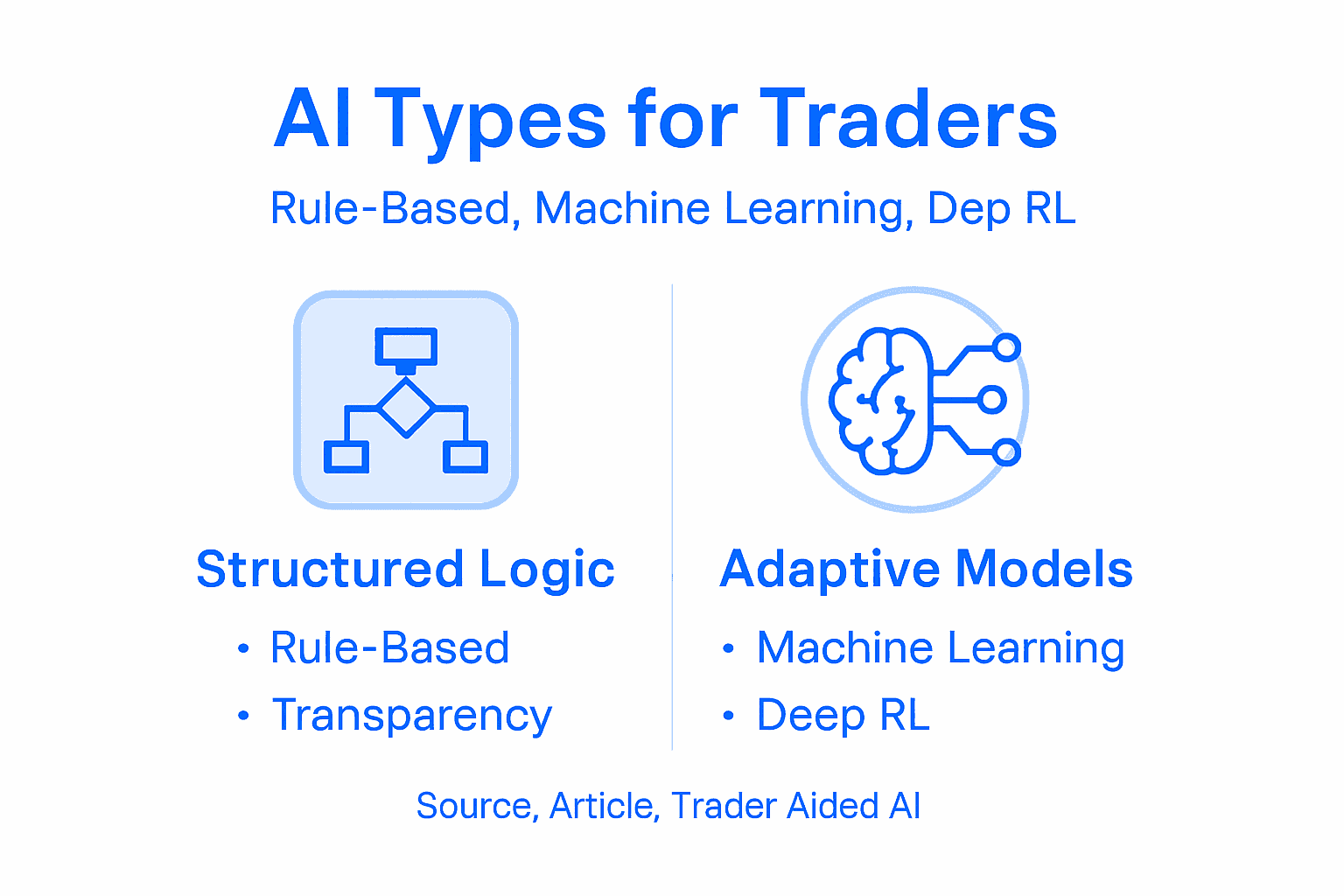
Machine learning models identify patterns in historical data automatically. Instead of you programming rules, the algorithm learns which price movements and indicators predict future price action. The system adapts as market conditions shift, making it ideal when your intuition recognizes patterns too complex to articulate explicitly.
Deep reinforcement learning treats trading like a game where the AI learns optimal decisions through trial and error against historical market data. The system discovers strategies you never considered by testing millions of decision combinations. This approach requires more computational resources but can uncover non-obvious edges.
Each type offers distinct tradeoffs:
Here’s how the main types of trader-aided AI differ:
AI Type | Core Approach | Strengths | Ideal For |
Rule-based Systems | Follows explicit rules | Maximum transparency | Traders with clear pattern edge |
Machine Learning Models | Learns from data patterns | Automatic pattern discovery | Traders with complex intuitions |
Deep Reinforcement Learning | Trial-and-error strategy | Finds novel tactics | Advanced users seeking innovation |
Rule-based - Maximum transparency, lowest computational cost, requires explicit edge definition
Machine learning - Automatic pattern discovery, moderate computational cost, less interpretable
Deep reinforcement learning - Finds novel strategies, the highest computational cost, most complex to implement
Platforms Enabling Trader Aided AI
Modern trader-aided AI platforms fall into several categories. Rule-based systems, machine learning models, and deep reinforcement learning represent the major technical foundations. Beyond these, platforms differ in how they connect trader intuition to algorithmic execution.
Algorithmic trading platforms provide infrastructure for backtesting, execution, and risk management. Many now integrate natural language processing to capture your trading rationale in conversation, then translate it into testable algorithms.
Cloud-based AI services offer scalability without maintaining expensive servers. They handle data processing, model training, and live trading across distributed systems. This suits traders who want algorithmic power without infrastructure complexity.
Hybrid platforms combine rule-based execution with machine-learning enhancements. You define core rules based on your intuition, and the AI optimizes parameters and adds pattern recognition layers. This approach balances interpretability with sophistication.
Key platform selection criteria:
Intuition capture mechanism - How naturally does it let you express your trading logic?
Backtesting fidelity - Does historical testing accurately reflect live trading conditions?
Execution speed - Can it handle your target trading frequency?
Risk management - What controls prevent catastrophic losses?
Cost structure - Does pricing scale with your account size and trade frequency?
The right platform disappears from your awareness—you focus on trading intuition, not technical implementation.
Pro tip: Start with a platform that matches your current edge definition. If you can’t articulate your trading logic clearly today, begin with rule-based systems before advancing to machine learning models.
Practical benefits and real-world use cases
Trader-aided AI delivers measurable results in live markets. The benefits extend beyond theoretical performance—they show up in execution speed, accuracy, and consistency. Real traders across stocks, cryptocurrencies, and derivatives are already capturing these gains.
The practical advantage boils down to this: your intuition gets faster and more disciplined. You maintain strategic control while algorithms handle the mechanical execution. This hybrid approach eliminates the friction between recognizing an opportunity and acting on it.
Enhanced Predictive Accuracy and Execution
Enhanced predictive accuracy and faster trade execution represent the foundational benefits. AI processes market data—price, volume, order flow, volatility—faster than human analysis allows. Your intuition identifies what to trade. AI ensures that how you trade maximizes statistical probability.
Consider a pattern your intuition recognizes: when volatility spikes after earnings, reversions follow. You’ve seen this repeatedly. But timing entry and exit precisely? That’s where AI excels. It executes at microsecond precision, capturing the statistical edge you identified.
Real-world impact manifests across three dimensions:
Latency reduction - From decision to execution in milliseconds instead of seconds
Consistency - Rules execute identically every time conditions trigger, eliminating emotional variance
Scale - Monitor 500 positions simultaneously, where manual management caps at 20
Concrete Market Applications
High-frequency trading represents one extreme. Algorithmic traders operating at the microsecond level rely entirely on AI. Your role shifts from execution to strategy design. You set the parameters your algorithms optimize within, then let machines compete on speed.
Portfolio optimization sits at the other end. Rather than manually balancing positions, AI continuously rebalances based on your risk tolerance and return targets. Your intuition guides portfolio construction. AI handles the mechanical rebalancing across hundreds of holdings.
Market anomaly detection catches opportunities humans miss. When a stock’s trading pattern deviates from its historical norm, AI flags it. Your intuition decides whether to trade the anomaly or skip it. The system removes the burden of constant monitoring.
Real implementations in live markets include:
Stock market trading - AI executes technical patterns that traders recognize intuitively
Cryptocurrency markets - Continuous 24/7 monitoring across volatile assets
Options strategies - Manages complex multi-leg positions automatically
Risk management - Stops losses and locks profits without emotional delays
The Human-AI Advantage
Trader-aided AI works because it respects the strengths of each system. AI provides continuous monitoring and risk management. You provide strategic oversight and judgment. Together, this combination improves robustness in dynamic market conditions.
A pure algorithmic system breaks when market structure changes. Your intuition recognizes the change immediately. You pause the algorithm, adjust parameters, and resume. This flexibility is impossible for fully automated systems that don’t incorporate human oversight.
The most powerful edge isn’t pure automation or pure intuition. It’s the combination executing flawlessly in real time.
Pro tip: Start measuring success by consistency of execution, not trading results alone. If your AI system captures 85% of your intuitive edge with zero emotion, that’s a win even if profitability doesn’t double immediately.
Risks, compliance, and common pitfalls
Trader-aided AI introduces real risks alongside genuine benefits. The systems you deploy can amplify losses as easily as profits. Understanding the pitfalls separates traders who use AI responsibly from those who get blindsided by failures they didn’t anticipate.
The risks fall into three buckets: technical failures, regulatory exposure, and model blindness. Each requires different mitigation strategies. Ignoring any of them exposes you to catastrophic outcomes.
Technical and Operational Risks
Your AI system can fail in ways pure human trading cannot. A bug in your algorithm executes thousands of bad trades before you notice. A data feed disconnection causes the system to make decisions on stale prices. Backtesting results that looked perfect turn into real losses because live markets behave differently.
Overfitting represents the most common trap. You optimize your algorithm against historical data until it captures every quirk and noise pattern. The system performs beautifully on data it’s already seen. Then live markets introduce new conditions, and your edge evaporates.
Common technical pitfalls include:
For quick reference, here are common risks and their mitigation strategies:
Risk Category | Typical Issue | Mitigation Strategy |
Technical Failure | Algorithm bugs or data outage | Real-time monitoring and fail-safes |
Regulatory Exposure | Compliance breaches | Document models and maintain the audit |
Model Blindness | Missed judgment calls, bias | Regular review and human intervention |
Insufficient validation - Testing only on in-sample data without holdout periods
Data snooping - Optimizing parameters until results look statistically significant by chance
Survivorship bias - Backtesting only against stocks that exist today, ignoring delisted companies
Execution slippage - Assuming entry prices that won’t fill in reality
Liquidity assumptions - Trading positions that can’t actually be exited at the size required
Model Opacity and Bias
Algorithmic bias, lack of explainability, and data privacy concerns present systemic risks. Your algorithm might trade on patterns that correlate with demographic biases rather than genuine market signals. You won’t notice because the trades still generate profits—until regulators find out.
When deep learning models make decisions, even the engineers who built them can’t fully explain why. This opacity creates compliance nightmares. Regulators increasingly demand that you understand and justify every trade your system executes.
Bias manifests subtly. Your AI might consistently underweight certain securities because training data reflected historical market inefficiencies that no longer exist. The model learned a ghost pattern.
Compliance and Regulatory Requirements
Compliance with soundness, transparency, and ethical standards isn’t optional. Financial regulators now scrutinize AI systems. You need robust governance frameworks to demonstrate control.
Key compliance obligations include:
Model documentation - Explain exactly how your algorithm makes decisions
Testing protocols - Demonstrate that you validate across multiple market regimes
Risk controls - Show safeguards preventing runaway losses
Audit trails - Maintain records of every trade and the logic triggering it
Bias testing - Prove your model doesn’t discriminate systematically
Your edge means nothing if regulators shut down your account for compliance violations or the algorithm blows up during market stress.
The cost of non-compliance ranges from fines to account closure to personal liability. Treat compliance as a feature, not friction.
Pro tip: Before deploying any trader-aided AI system, run stress tests simulating 2008-level market crashes and 2020-level volatility spikes. If your algorithm survives those scenarios without catastrophic losses, you’ve got real risk management. If it doesn’t, you have a liability, not an edge.
Unlock the Full Potential of Trader Aided AI with NvestiQ
The article highlights the challenge traders face in capturing and translating their unique intuition into consistent, rule-based execution without losing the human edge. If you struggle with turning your intuitive market insights into automated strategies or worry about maintaining transparency and control, you are not alone. Concepts such as intuition capture and algorithmic translation demand a platform designed to understand why you make certain trading decisions and test them with rigor across different market conditions.
At Nvestiq, we have created the world’s first platform that comprehends the nuance of real trader intuition, allowing you to tie a simple conversation directly into a proven, quantifiable edge. Our technology helps you bridge the gap between your intuitive edge and algorithmic precision while maintaining accountability and transparency. Whether you want to start with explicit rule-based models or explore sophisticated machine learning layers, Nvestiq supports your unique trading style with real-time feedback, pattern recognition, and robust risk controls.
Take the next step in elevating your trading by experiencing how intuitive insights become actionable strategies. Visit our landing page now to see how Nvestiq can empower your trader-aided AI journey.
Discover how to capture your edge faster and more accurately with a platform built for trader intuition. Start converting your gut feeling into consistent, disciplined execution today by learning more at NvestiQ. Your intuition matters. Let us help you prove it.
Frequently Asked Questions
What is Trader Aided AI?
Trader Aided AI refers to the integration of human trader intuition with algorithmic trading systems, allowing the AI to learn from human decision-making patterns and translate those insights into actionable trading strategies.
How does Trader Aided AI work?
The system captures trader rationale through natural conversation, translates that into machine-readable rules, and tests those rules against historical data to derive trading strategies, all while continuously adapting to live market conditions.
What are the core principles guiding Trader Aided AI?
Core principles include soundness, accountability, fairness, ethics, transparency, and skill alignment, ensuring that AI systems produce reliable results while respecting human insight and oversight.
What types of AI systems are available for trader-aided approaches?
The major types include rule-based systems, machine learning models, and deep reinforcement learning approaches, each suited for different trading styles and requiring varying levels of trader input and oversight.